Rn

Gaurav Vyas

What survives
the sieve.

Student of IIT Guwahati in B.Sc. (Hons.) Data Science & Artificial Intelligence, with degree research in deep-learning side-channel cryptanalysis (certified 16/16 byte AES-128 key recovery from power traces), vision-language mathematical document AI, and computational neuroscience — complemented by advanced statistical training as a student of ISI Kolkata (Post Graduate Diploma in Applied Statistics, competitive merit entrance, full scholarship) alongside published mathematical records in the OEIS.

Every number above is really sieved in your browser — composites struck out, primes left standing. The gold ones are Ramanujan primes, and the twelve across the top are my projects. Click one.

sieveinitialising π(N) Ramanujan check
B.Sc. Degree
IIT Guwahati (Data Science & AI)
Side-channel DL · Vision AI · CPI 7.5
Degree Research
Deep-learning cryptanalysis, document AI,
spiking neural connectome models
PG Diploma
ISI Kolkata (Applied Statistics)
Merit Entrance · Full Scholarship
Reach me
g.vyas@op.iitg.ac.in
replies within a day

01

The work

Twelve things, each anchored to the Ramanujan prime that indexes it above. Numbers below are measured, not estimated.

  1. IIT Guwahati Degree Research • Deep Learning • Security

    A 128-bit AES key, out of power traces

    Deep-learning side-channel attack with certified key enumeration, on real ASCAD traces.

    • 16/16 key bytes recovered
    • log2 rank ≤ 1 across 3 seeds
    • 220 → 6.7 traces needed at a 232 budget
    • Domain adaptation under desynchronisation

    Domain adaptation rescues the attack under desynchronisation (guessing entropy 0 at 2,000 adaptation traces) but not across acquisition campaigns, where the target signal is simply weaker — SNR 1.6 against 6.9. Reported as the mixed result it is.

    Three separate bugs here all presented identically: validation loss stuck near ln(256), rank near random. None were hyperparameter problems. The distributed traces window a different key byte than assumed; under first-order masking either share alone carries no key information; and 45.9M of 47.3M parameters were funnelling through one linear bottleneck that memorised the profiling set.

  2. Computational neuroscience • Spiking Neural Networks

    DROSOMIND — In-Silico Connectome Organism

    A closed-loop cybernetic organism driven by the complete 3D male fruit fly connectome (166k neurons, 125M synapses) from Google Research’s landmark Cell 2026 publication.

    • 166k neurons • 125M synapses rendered
    • 16-wedge ring attractor heading compass
    • ~34 ms IPI courtship song Web Audio synthesis
    • 100% in-browser WebGL, 0 dependencies

    Directly models Google's newly mapped sexual dimorphism discovery: the male-specific bilateral P1 courtship hub that coordinates unilateral wing singing, paired with lobula giant-fiber escape reflexes and optomotor flow. Runs a biophysical Leaky Integrate-and-Fire spiking neural network coupled to an articulated 3D Drosophila body in real time.

  3. Vision-Language • Document AI

    Handwritten mathematics → compilable LaTeX PDFs

    Multimodal LoRA fine-tunes of GLM-OCR and Baidu OCR models to transform unconstrained handwritten mathematics into complete, standalone compilable LaTeX PDFs.

    • 0% → 82.4% compile rate (88.9% on v3.1)
    • 0.382 mean CER — 25.9% relative cut vs base
    • 13,973 validated pairs from 34,080 raw scans
    • GGUF models verified on Hugging Face

    Fine-tunes GLM-OCR (0.9B) and Baidu OCR via LoRA on a single RTX 3060 12GB to transcribe unconstrained handwritten university-level mathematics into complete, pdflatex-compilable LaTeX documents. Takes the compile rate on the 700-page held-out test benchmark from 0.0% (frozen base) to 82.4% (v4.1) / 88.9% (v3.1) while lifting Math-F1 to 0.827.

    Curated a 34,080-scan pipeline yielding 13,973 validated image–LaTeX pairs, with every training target confirmed to compile before training. Solved autoregressive preamble failures by fine-tuning on document bodies and emitting compilable standalone LaTeX.

    Evaluated on a 700-page held-out test split across 15 logged metrics. Pre-quantized GGUF models built and verified on GPU for private, offline local inference via llama.cpp.

  4. Reinforcement Learning • Null result

    Self-play RL that didn’t work — and the report that says so

    A 760,717-parameter AlphaZero-style chess engine, and an honest account of its failure.

    • 46.2% vs baseline (95% CI 37.4–55.1)
    • 159 logged eval points found meaningless
    • 76 checks + 6/6 mutation tests catching real shipped bugs

    Training loss fell 2.36 → 1.85 the entire run while the network got no stronger. The evaluation had been scoring White’s games while the network alternated colours, so every logged point sat pinned at 50% and carried zero information. An earlier run was measurably worse than its own starting point — 31.2%.

    The binding constraint turned out to be sample efficiency: 128 simulations is 4.3 visits per legal move, against AlphaZero’s ~27. I could have reframed this as a success story about infrastructure. It is published as a null result instead.

  5. Data Science • Probabilistic Belief Modeling

    Drishti — Post-Disaster Belief Resolution

    A post-disaster information-fog resolver: calibrated belief over settlement-level reports, for when the reports contradict each other.

    • Calibrated belief — Bayesian inference over conflicting field data
    • Graph routing — emergency logistics over damaged networks
    • Zero dependency — runs locally on portable field hardware

    Resolves conflicting crisis reports from ground scouts, emergency responders, and remote sensors during disaster response. Employs probabilistic inference and Bayesian belief networks to filter noise and misinformation, generating high-confidence situation maps and logistics routes.

  6. Agentic systems • Symbolic Planning

    RouteGuard — supply-chain recovery without an LLM

    A symbolic, model-based planning agent for autonomous retail recovery. No API keys, no pip install, no build step.

    • 17/17 tests, 80/80 oracle agreement
    • 100 units · ₹11,700 · 38 kg CO₂e · ETA 22 h
    • stdlib only — Python with zero dependencies

    The browser build isn’t a reimplementation you have to take on faith. A conformance check replays the committed evidence event by event — including SHA-256 receipt digests, all five scenarios and all eighty benchmark cases with identical search counts. If the JavaScript engine drifts from the Python one, the deploy fails.

  7. Computational Mathematics

    The seven Millennium Prize Problems, simulated

    All seven explained for non-mathematicians, each with real mathematics running live in the browser.

    • 7 interactive simulations
    • ~2e-5 accuracy on computed zeta zeros
    • 0 dependencies, 32/32 links verified

    Elliptic-curve point counts are checked against brute force over Fp², rational points use exact BigInt arithmetic, and nothing on the page is faked or hardcoded. Navier–Stokes is framed as claimed rather than settled, because that is what it currently is.

  8. Interactive Mathematics

    Mathematical Surprises

    Interactive mathematics and physics visualisations — the results that don’t look like they should be true.

  9. Published mathematics • Sequence Records

    Ramanujan primes in the OEIS (A181671 & A190502)

    Extended the count of Ramanujan primes to 1023 in base 10 and 272 in base 2 — permanently, inside the reference work itself.

    • A181671: a(18)–a(23) accepted 15 Aug 2026
    • A190502: a(57)–a(72) accepted 13 Sep 2026
    • 2 independent π(x) algorithms agree
    • 1 laptop, 12 threads, no cluster

    A bracketing-lemma pipeline: primecount at O(log Q) grid endpoints, a 128-bit segmented sieve, and Dusart 2010 / Johnston 2022 analytic tail bounds.

    The part worth defending is the anchoring. Every π-value the pipeline leans on matches the published b-files of A007053 and A190502 exactly — computed by different people, with different code, years earlier. So the anchors need no re-running to be trusted, and the only quantity this work uniquely contributes is one small integer per term.

    Accepted in OEIS: On 13 Sep 2026, the base-2 sibling sequence (OEIS A190502, a(57)–a(72)) was reviewed and approved by editor Joerg Arndt. The official b-file now extends through n = 72 and links directly to ramanujan-primes-beyond-2-56.

  10. Systems • Computer Vision

    HemispheR-py & Android — Canopy Photography from First Principles

    Clean-room Python package ported directly from optical physics and canopy geometry without consulting R code — accompanied by a native Android app for real-time field analysis.

    • Clean-room implementation — 0 lines of R code consulted
    • Native Android app — on-device field canopy processing
    • Real-time gap fraction • sub-pixel fisheye geometry
    • Zero heavy dependencies — runs offline on mobile & edge hardware

    Re-engineered the entire canopy hemispherical photography workflow into pure Python from scratch, derived purely from first-principles optical canopy geometry, Beer–Lambert light extinction models, and equidistant/equisolid lens projections, without reading the original R package implementation.

    Engineered a companion native Android application for forestry researchers and ecologists, enabling direct image acquisition via mobile fisheye attachments and immediate on-device calculation of sky-canopy binarization, optical gap fraction, and effective Leaf Area Index (LAI) in remote field conditions without internet or cloud compute.

  11. Product • Systems

    CarbonCampus — campus carbon accounting, offline

    A PWA that computes a campus footprint with no backend and no network connection.

    • Offline-first — IndexedDB, no server required
    • One engine shared by the app and the API
    • 100% client-side carbon accounting

    An npm workspace where the emission-factor registry and computation engine are imported by both the PWA and the Fastify server, so the offline and online paths cannot quietly disagree with each other. Deployed backend-less on purpose.

  12. Game Development • Engine

    Voltfall — a 94 KB Android roguelite

    A custom engine on SurfaceView. Every sprite and every sound is generated at runtime.

    • ~94 KB release APK
    • 0 third-party runtime dependencies
    • No INTERNET permission at all

    The size is the product, not an accident of scope. Declaring no network permission is precisely what lets the Play Data Safety form honestly answer “no data collected” — adding a single ads or analytics SDK would invalidate the privacy policy, the EULA and that answer all at once.

02

How I work

Three habits, each with the specific mistake that taught it.

Anchor to someone else’s numbers.

Self-verification proves nothing. The prime counts underpinning my OEIS submission match a table computed twelve years earlier by different people running different code — so a reviewer can check the work without re-running any of it.

Independent confirmation beats a certificate you wrote yourself.

Measure before you tune.

A stuck loss looks like a hyperparameter problem and almost never is. Three times now the real answer was that the input carried no signal, or that one layer held 97% of the parameters. Check what’s in the data and where the weights are first.

Learning rates are the last thing to touch, not the first.

Publish the null result.

My chess engine’s self-play training produced no measurable gain, and the report says so in the abstract. I also found that the metric which had said otherwise was broken. Both facts are in the public repository.

A result you can trust is worth more than one you wanted.

03

Education

  1. Oct 2023 – Sep 2027

    B.Sc. (Hons.) Data Science & Artificial Intelligence

    Indian Institute of Technology Guwahati (Online Degree Program). CPI 7.5. Degree research in deep-learning side-channel cryptanalysis (certified 128-bit AES recovery), vision-language mathematical document AI, and reinforcement learning.

  2. Aug 2026 – Aug 2027

    Post Graduate Diploma in Applied Statistics (PGDAS)

    Indian Statistical Institute, Kolkata (Online Program). Qualified for the ISI PGDAS Admission Test 2026 and received a full tuition fee waiver (Full Scholarship). Specialized coursework across mathematical statistics, probabilistic modeling, inference, and computational data analysis.

Experience & Contributions

  1. May 2021 – Mar 2026

    Advanced Math Expert — Chegg Inc.

    Part-time · 4 yrs 11 mos. Solved 1,187+ advanced mathematics problems with worked, step-by-step explanations and verified accuracy.

  2. 2026

    OEIS contributor — A181671 & A190502

    Published contributor to the On-Line Encyclopedia of Integer Sequences: six terms in A181671 (15 Aug 2026), and 16 terms in A190502 through 272 (13 Sep 2026).

Tools I actually reach for

PythonPyTorchNumPyC / C++Kotlin TypeScriptReactLaTeXCUDAGit LoRA / PEFTHugging Facescikit-learnOpenCV

04

Let’s talk.

Open to research collaborations, computational mathematics & AI projects, internships, and anything where being right matters more than being fast.

Academic · IIT Guwahati g.vyas@op.iitg.ac.in
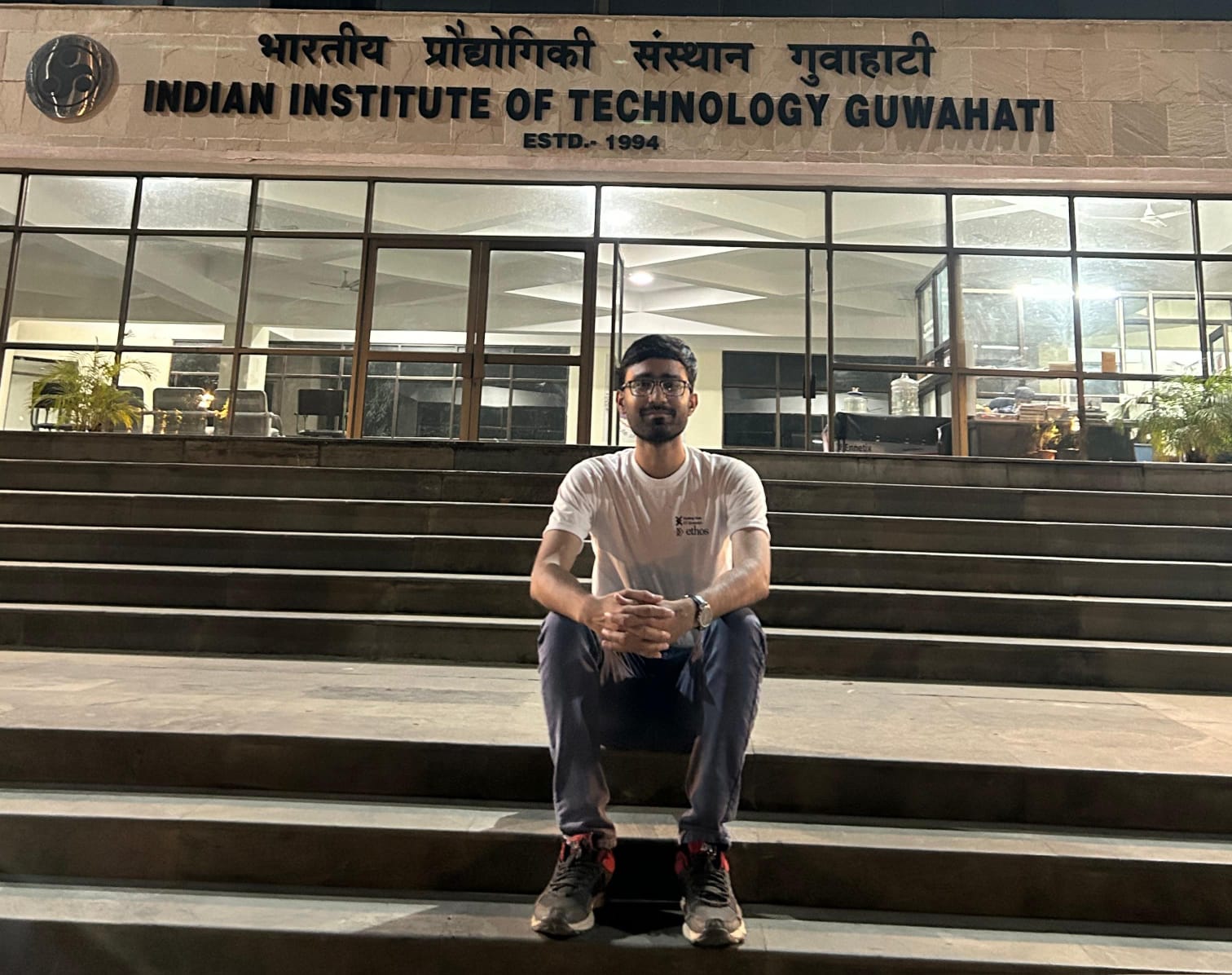
Portrait of Gaurav Vyas

Send a message

Delivered straight to my inbox (with IITG email in CC).